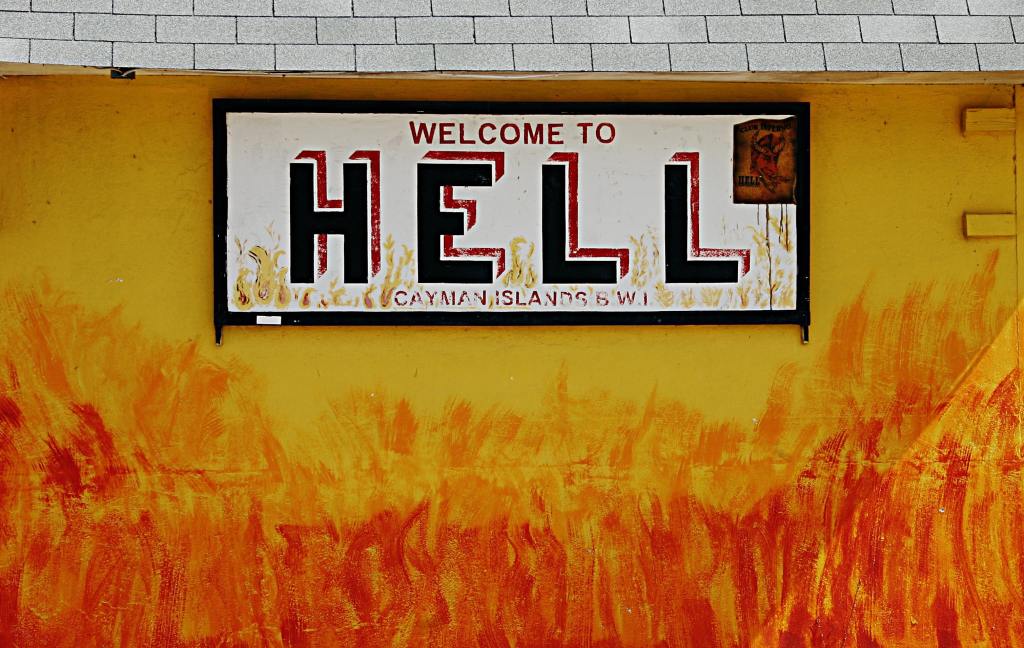
When I was a teenager hell felt so much more real than heaven ever did. The act of “believing” or “having faith” seemed to be geared 100% at avoiding hell so that you could go to heaven. The fear of hell was burned into us (horrifying pun intended), to the point to where I would sometimes fear the ground opening up and swallowing me whole.
Note that I never fantasized about heaven taking me away, just about pain, torment, and death. I remember hearing sermons at youth camps taking verses out of context to talk about how bad it would hurt to be in hell, so we better “accept Jesus” now or we might be in a car crash on the way home and end up in hell forever.
It wasn’t until much, much later that I learned that this concept of hell that I had been given really can’t be found in the Bible (at least in a faithful reading of it). It has more to do with developments coming out of the middle ages than anything else.
In much of the Hebrew Scriptures the concept is of Sheol, or the place of the dead. It honestly has a lot more in common with Hades in Greek mythology than the Hell of late Christianity. It was a dreary place where everyone went when they died.
It’s possible that some even believed in no afterlife. That one’s eternal life was found in their descendants. Thus the promise to Abram of descendants more numerable than the stars was a promise of eternal life through offspring.
The point of my rambling, however, is that the concept of the afterlife is not rock solid in the Bible. Yes there are promises of eternal life and resurrection, but even among Christians those ideas are debated as to what they really mean. So to use hell as the primary motivator to scare children into baptism seems suspect at best, abusive at worst.
I long for a world for my children where they can make choices of right and wrong, of good and bad, because it’s the right thing to do; not because someone is threatening them with fire and torture. One of my greatest joys as a parent was when my son decided to be baptized. When I asked why, he said he wanted to do what God asks of us (like love neighbors and be kind to one another).
Later, after this, he asked me one day what happens when we die. I was honest. I don’t know, but my hope is that there is something after, and that I trust that to die is to be with God, whatever that means.
It gives me hope that his decision was not based on fear of hell or promise of paradise but simply on the fact that God’s message of loving neighbors and being kind was the right way to live. It’s a hope that faith can be helpful, uplifting, and hopeful, in spite of all the pain, trauma, and abuse it’s caused, even in my own life.
 Blake Hart
Leave a comment